
The Ultimate Guide to Commercial Property Maintenance in Franklin and Nashville
Why Commercial Property Maintenance in Franklin, TN Demands More Than the Basics
Commercial property maintenance in Franklin is one of the most important investments a Middle Tennessee property owner or manager can make, and one of the most overlooked until something goes wrong.
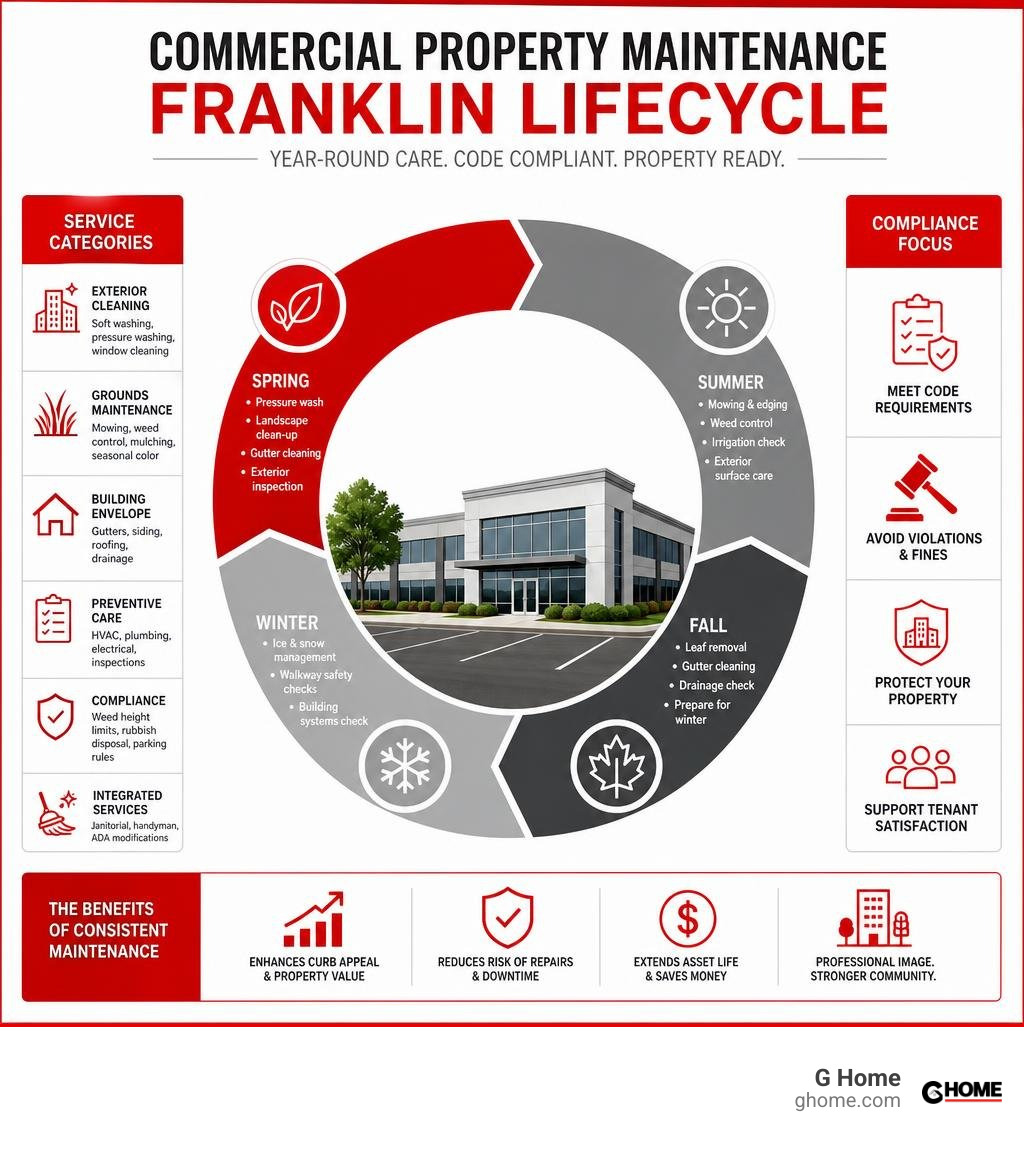
Here’s a quick look at what Franklin commercial property maintenance typically covers:
| Service Category | What It Includes |
|---|---|
| Exterior cleaning | Soft washing, pressure washing, window cleaning |
| Grounds maintenance | Mowing, weed control, mulching, seasonal color |
| Building envelope | Gutters, siding, roofing, drainage |
| Compliance | Weed height limits, rubbish disposal, parking rules |
| Preventive care | HVAC, plumbing, electrical, inspections |
| Integrated services | Janitorial, handyman, ADA modifications |
Franklin’s growth as one of Middle Tennessee’s fastest-growing cities means more commercial properties competing for tenants and customers. An unkempt storefront or neglected exterior doesn’t just hurt curb appeal. It can cost you leases, trigger municipal code violations, and lead to expensive structural repairs that a simple maintenance routine could have prevented.
The City of Franklin enforces the International Property Maintenance Code, which sets clear minimum standards for every commercial premises. Falling behind on even basic upkeep, including overgrown landscaping, accumulated rubbish, or damaged building exteriors, can result in formal notices of violation and daily fines from the city.
And then there’s the climate. Franklin’s humid summers, heavy seasonal pollen, freeze-thaw winters, and storm-driven debris create year-round pressure on commercial building exteriors. Gutters clog. Algae spreads across siding. Walkways become slip hazards. The maintenance demands here are real and ongoing.
I’m Matt Smith, CEO of G Home and founder of Gutterglove, with over 25 years of experience protecting commercial and residential properties across the country, including right here in Franklin, where commercial property maintenance in Franklin sits at the core of what we do. This guide pulls together everything you need to stay compliant, protect your investment, and keep your property looking its best year-round.
Key Standards for Commercial Property Maintenance Franklin
When you manage a business or retail space in Franklin, maintaining your property is not just a matter of pride—it is a legal obligation. The City of Franklin takes community preservation very seriously, which is why local code enforcement officers actively monitor business districts, industrial parks, and retail centers to ensure they adhere to strict local and international standards.
The City of Franklin officially adopts and enforces the International Property Maintenance Code (IPMC) alongside local municipal codes. These regulations set the baseline for public safety, sanitation, and structural integrity. For property managers, this means that a quick drive-by inspection is not enough. You need to understand the exact rules that keep your business compliant and open for operations.
To help you stay ahead of local inspectors, you can explore more info about our commercial services in Franklin to see how we help businesses maintain their physical structures to meet these rigid standards.
Common Violations and How to Avoid Them
The easiest way to avoid costly penalties is to understand what local inspectors look for. In Franklin, several common maintenance pitfalls frequently lead to formal citations:
- Overgrown Vegetation and High Grass: Franklin municipal code dictates that all grass, weeds, and annual plant growth must be maintained under twelve (12) inches in height. This rule excludes cultivated gardens, managed agricultural zones, and mature trees or shrubs, but it applies strictly to turfgrass and perimeter weeds. If your property borders a vacant lot or a utility easement, those areas must also be kept clear.
- Accumulated Rubbish and Garbage: All exterior premises must be kept free of accumulated trash, broken shipping pallets, discarded retail inventory, and general debris. Rubbish must be stored in approved, clean, and sanitary containers.
- Improper Parking and Soil Erosion: Parking commercial or passenger vehicles on unapproved surfaces, such as lawns or landscaped areas, is strictly prohibited. Vehicles must only be parked on concrete, asphalt, or other approved parking pads to prevent soil erosion and stagnant water accumulation.
- Building Envelope Neglect: Faded paint, peeling siding, rusted metal awnings, and broken windows are more than just eyesores; they are code violations. The IPMC requires the exterior building envelope to be structurally sound, weather-tight, and free of visible decay.
If a property owner fails to address these issues, the City of Franklin issues a formal Notice of Violation (NOV). If the violation is not resolved by the specified due date, a citation to appear in Municipal Court is issued. The court can levy compounding daily fines for each day the violation persists. In extreme cases, the city exercises its right to abate the violation themselves, such as hiring a crew to clear the rubbish or cut the grass, and takes legal action to recover the costs directly from the property owner.
Executing proactive inspections of your building envelope, landscaping, and waste disposal areas is the single best defense against municipal court citations.
Seasonal Challenges and Preventive Strategies for Middle Tennessee

Middle Tennessee is beautiful, but our climate puts commercial building materials through a relentless workout. From the heavy pollen storms of spring to the sudden freeze-thaw cycles of winter, each season presents a unique set of challenges to the structural integrity and aesthetic appeal of your property.
Failing to adapt your maintenance schedule to these regional shifts is a recipe for premature wear and high repair bills. To help you plan your budget and coordinate your facility teams, we have outlined the critical seasonal tasks required to protect your investment throughout the year:
| Season | Key Focus Areas | Critical Maintenance Tasks |
|---|---|---|
| Spring | Pollen removal, gutter prep, landscaping | Wash pollen and grime from facades; inspect and clear gutters after spring storms; apply pre-emergent weed control to landscape beds. |
| Summer | High humidity, weed control, turf health | Monitor irrigation systems; execute weekly mowing to stay under the 12-inch limit; inspect exterior surfaces for rapid algae and mold growth. |
| Autumn | Leaf clearing, gutter protection, winterization | Perform deep gutter cleaning to prevent winter clogs; clear fallen leaves from parking lots and walkways; winterize commercial irrigation systems. |
| Winter | Freeze-thaw protection, ice safety, interior turns | Clear snow and ice from walkways and stairs promptly; inspect pipes for freeze hazards; execute indoor repairs and deep cleaning during off-peak months. |
Why Local Expertise Matters for Commercial Property Maintenance Franklin
It is tempting for regional property managers to hire massive, national facility management chains. However, national providers often operate out of distant corporate offices, managing local properties through automated phone trees and standardized checklists that completely ignore Middle Tennessee’s unique climate realities.
Local expertise matters because regional weather patterns dictate your maintenance timeline. For example, a local provider knows that our high summer humidity accelerates the growth of Gloeocapsa magma—the dark, streak-like algae that feeds on commercial roofing materials and stains exterior siding. They know exactly when the local pollen drop occurs and how to clear it before it bakes onto your windows and clogs your HVAC intake filters.
Furthermore, local teams understand the logistical realities of working within historic districts like Downtown Franklin, where strict historical preservation guidelines govern how exteriors can be washed and maintained. By utilizing local Facilities Management Insights, you can ensure your property is cared for by professionals who understand local regulations, climate challenges, and municipal expectations.
Exterior Preservation: Soft Washing vs. Pressure Washing
When environmental grime, vehicle exhaust, and organic growth begin to dull your commercial facade, cleaning it is essential. However, the method you choose to clean those surfaces can mean the difference between a pristine storefront and thousands of dollars in property damage.
Traditional pressure washing uses high-velocity water (often exceeding 3,000 PSI) to physically blast dirt away. While this is highly effective for hard, durable surfaces like concrete walkways, dumpster pads, and brick entryways, it is incredibly dangerous for delicate building envelopes. High-pressure water can easily strip paint, crack vinyl siding, shatter window seals, and tear through commercial roofing membranes.
This is where professional soft washing comes in. Soft washing utilizes low-pressure water systems (usually under 500 PSI, similar to a strong garden hose) combined with specialized, biodegradable cleaning solutions. These detergents do not just rinse dirt away; they treat and sanitize the surface, killing algae, mold, mildew, and moss at the root.
If you want to maintain a clean, professional look without risking structural damage, you can Learn more about our commercial services to see how we safely preserve building exteriors across Middle Tennessee.
Protecting Delicate Commercial Surfaces
Using the correct washing technique is a critical component of risk management. Walkways, entryways, and parking spaces are highly susceptible to organic buildup. When rain or morning dew hits algae-covered concrete, it becomes incredibly slick, presenting a severe slip-and-fall liability for your employees and customers. Routine washing mitigates this risk entirely.
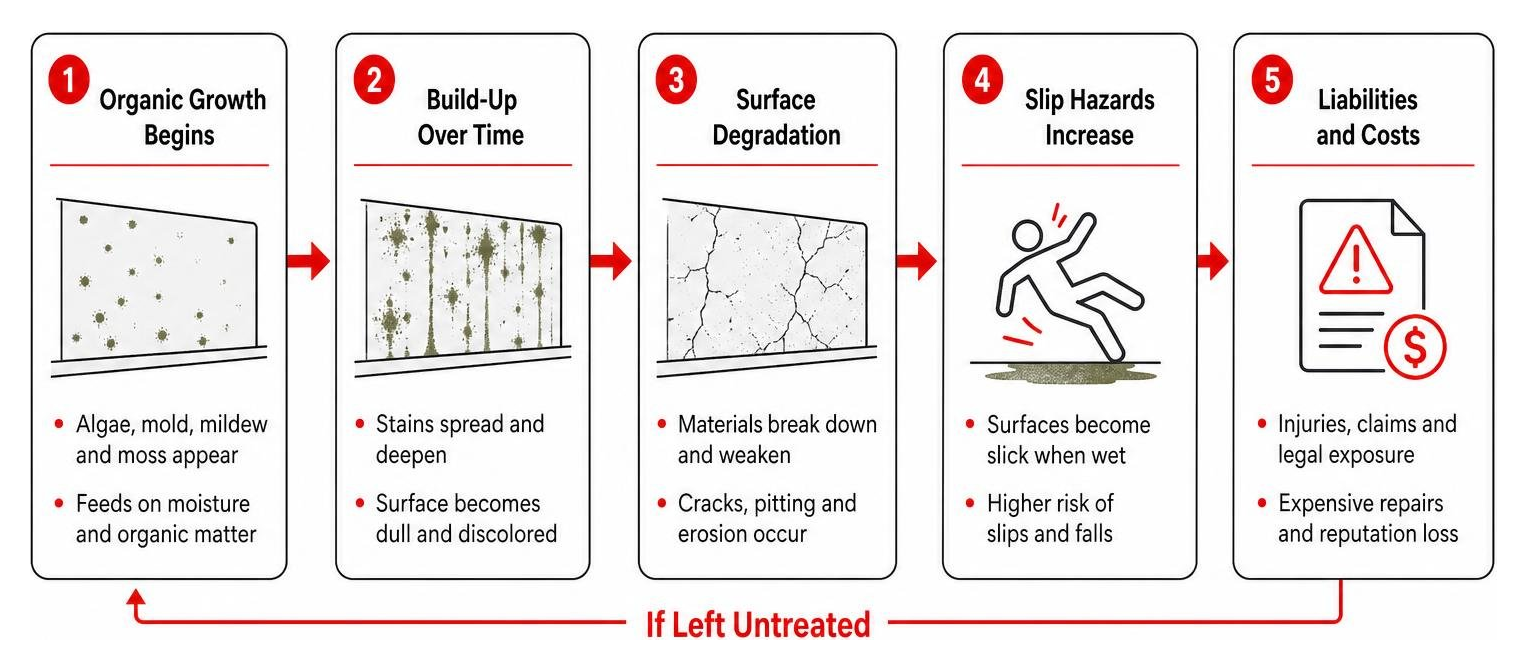
For the rest of your building envelope, soft washing protects delicate materials like:
- Commercial Siding: Whether your building features EIFS (stucco), vinyl, wood, or aluminum siding, soft washing removes stains without warping the panels or forcing water behind the siding, which can lead to hidden mold growth inside the walls.
- Awnings and Signage: High pressure can instantly shred fabric awnings and damage delicate electronic signage. Soft washing gently lifts dirt and bird droppings, preserving your brand’s visual identity.
- Roofs and Gutters: Accumulated dirt and organic growth act like a sponge, holding moisture against roofing materials and accelerating physical wear. Soft washing sanitizes the roof surface safely, extending its lifespan and protecting your structural integrity.
Streamlining Operations with Integrated Facility Services
Managing a commercial property involves a mountain of administrative work. If you are hiring one company to mow the lawn, another to clean the windows, a third to fix a leaky pipe, and a fourth to handle nightly janitorial duties, you are drowning in administrative overhead. You have to manage multiple contracts, coordinate conflicting schedules, and process dozens of monthly invoices.
Consolidating these services under a single, trusted partner simplifies your operations. Instead of playing phone tag with five different contractors when an emergency arises, you have a single point of contact who understands your property inside and out.
From managing seasonal transitions to overseeing complex building repairs, having an experienced hand coordinate your facilities is invaluable. Professional field operations, clear scheduling, and consistent communication help keep large-scale property portfolios running on time and within budget.
Choosing the Right Partner for Commercial Property Maintenance Franklin
When you are ready to hire a commercial maintenance provider, do not simply choose the lowest bidder. A cheap contract often comes with hidden risks that can leave you vulnerable to lawsuits or property damage.
Always verify that your chosen provider meets these strict professional standards:
- Comprehensive Insurance: Ensure the company carries robust general liability and workers’ compensation insurance. If an uninsured worker falls off a ladder on your property, your business could be held liable.
- Proper Licensing: The provider must hold all necessary local and state licenses to perform commercial work in Middle Tennessee.
- Full-Time, In-House Technicians: Look for a company that uses trained, full-time employees instead of relying heavily on subcontractors. In-house technicians are more accountable, better aligned with company standards, and more consistent from visit to visit.
- Direct Communication Channels: Avoid companies that route your service requests through distant call centers. You need direct access to decision-makers who can resolve on-site issues immediately.
- Geographic Proximity: Ensure the team actively services your specific municipality. You can review Our service areas to verify our coverage across Smyrna, Nolensville, Nashville, Franklin, Brentwood, Hendersonville, and Murfreesboro.
Frequently Asked Questions about Commercial Upkeep
How does regular maintenance improve tenant satisfaction and curb appeal?
Your property’s exterior is the ultimate differentiator. An unkempt building sends an immediate message to potential clients and tenants that you do not pay attention to details. For retail spaces, a dirty storefront directly reduces foot traffic and customer revenue. For office complexes, poor maintenance leads to higher tenant turnover; business owners do not want to invite clients to an office with clogged gutters, stained siding, or overgrown weeds. Regular maintenance preserves your property’s long-term value, keeps tenants happy, and ensures your building remains a local landmark for all the right reasons.
What is the maximum allowable grass height for commercial properties in Franklin?
The City of Franklin enforces a strict twelve (12) inch height limit for grass, weeds, and annual plant growth. This regulation is actively enforced to prevent pest infestations, rodent harborage, and soil erosion issues. If your property exceeds this limit, you risk receiving a formal Notice of Violation, municipal court citations, and compounding daily fines.
Why is gutter maintenance critical for commercial building foundations?
Commercial buildings often feature large flat roofs or expansive sloped roofs that collect massive amounts of rainwater. Without clean, functioning gutters, this water cascades directly down the side of your building. This causes immediate staining on your facade, accelerates siding decay, and pools directly at the foundation.
Over time, pooling water saturates the soil around your foundation, leading to cracking, shifting, and catastrophic structural failure. Furthermore, overflowing water near customer entryways creates dangerous ice hazards during our cold Middle Tennessee winters. Keeping your gutters clear and installing commercial-grade gutter protection is the single most cost-effective way to divert water safely away from your foundation. You can explore our Franklin service area to see how we help local businesses secure their drainage systems.
Conclusion
Commercial property maintenance in Franklin is not just about keeping up appearances; it is about protecting your long-term real estate investment, ensuring compliance with local codes, and providing a safe, welcoming environment for your tenants and customers.
At G Home, we bring over 25 years of specialized experience to Middle Tennessee, providing stress-free, professional gutter cleaning, gutter protection installation, and exterior soft washing services. We understand our local climate challenges and customize our solutions to keep your building envelope pristine year-round.
Do not wait for a clogged gutter to flood your entryway or a code violation notice to arrive in the mail. Contact our commercial maintenance team today to schedule a property consultation and let us handle your exterior maintenance while you focus on running your business.