
The Ultimate Commercial Pressure Washing Guide for Local Businesses
What Is Commercial Building Exterior Washing — and Why Does It Matter?
Commercial building exterior washing is the process of professionally cleaning the outside surfaces of a business property, including walls, siding, walkways, roofs, and entryways, to remove dirt, mold, algae, exhaust residue, and other buildup.
Here’s a quick overview of what you need to know:
| Question | Quick Answer |
|---|---|
| What is it? | Professional cleaning of a building’s exterior surfaces using pressure, power, or soft washing |
| Why does it matter? | Protects building materials, reduces liability, and improves curb appeal |
| How often is it needed? | Most commercial properties: 2x per year minimum; high-traffic properties: quarterly |
| Best method? | Depends on surface: soft washing for delicate materials, pressure washing for concrete |
| DIY or professional? | Professional recommended because commercial properties require specialized equipment and compliance knowledge |
Every day, your building’s exterior is exposed to exhaust fumes, biological growth, UV damage, and weather. Over time, that buildup doesn’t just look bad; it actively degrades your building materials and creates real safety and liability risks. Slip-and-fall claims from algae-covered walkways are among the most common premises liability cases across the country, and road salt can begin breaking down concrete and masonry within weeks of exposure.
The good news? A well-planned exterior cleaning program protects your investment, keeps your property safe, and makes a strong first impression on every customer who walks through your door.
Why Commercial Building Exterior Washing is Essential for Your Property
When you own or manage a commercial property, it’s easy to focus on what’s happening inside. But the outside of your property is your business’s handshake. It tells a story before a customer or prospective tenant even walks through the front door.
Investing in regular exterior maintenance is a matter of asset protection. When mold, mildew, algae, pollen, and urban pollutants are left to sit on your building’s facade, they trap moisture against the surface. This moisture intrusion can slowly rot wood, degrade mortar, and eat away at protective paint coatings.
Over time, this cumulative wear leads to expensive structural repairs. Regular washing prevents this degradation, keeping your building materials strong and extending their overall lifespan.
Safety and liability are also massive factors. Algae, mildew, and accumulated grime on walkways turn into slick, hazardous surfaces when exposed to rain or early morning dew. Slip-and-fall claims from dirty or algae-covered walkways are a primary cause of premises liability cases.
Additionally, keeping your property clean is a practical way to support employee morale and attract high-value tenants. Whether you operate a retail storefront, medical center, or office park, G Home provides commercial services that help businesses maintain safer, cleaner exterior spaces.
Pressure Washing vs. Power Washing vs. Soft Washing
Not all exterior cleaning is the same. Using the wrong method on the wrong surface can cause severe, irreversible damage.
To clean safely, you need to understand the differences between pressure washing, power washing, and soft washing. The main differences lie in water pressure (measured in PSI, or pounds per square inch), water volume (measured in GPM, or gallons per minute), water temperature, and the chemical solutions used.
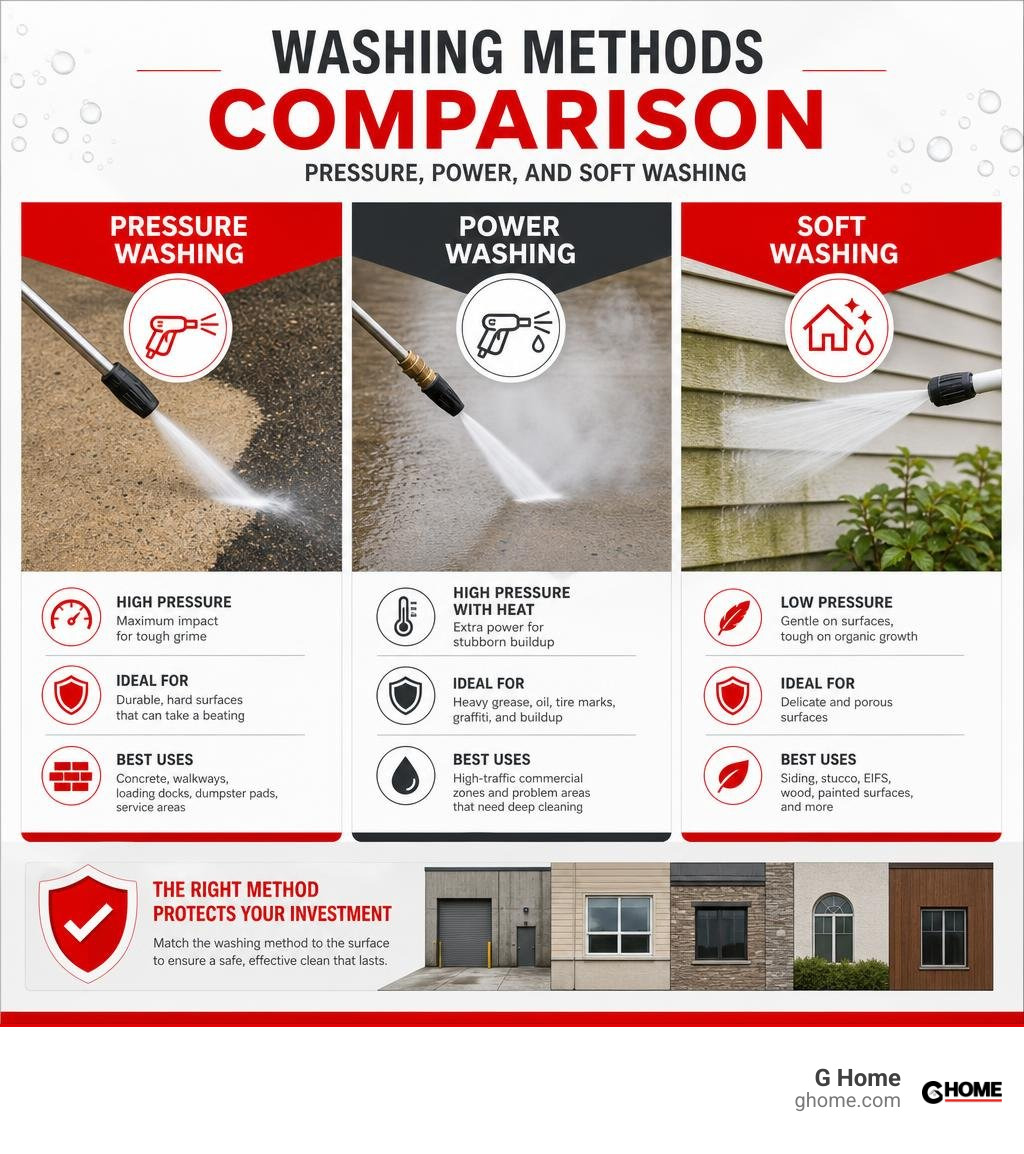
| Cleaning Method | Pressure Range (PSI) | Water Temp | Best Used For | Key Advantage |
|---|---|---|---|---|
| Pressure Washing | 1,500 – 4,000+ | Cold | Durable hardscapes (concrete, brick, stone) | Blasts away embedded dirt and grime |
| Power Washing | 1,500 – 4,000+ | Hot (Heated) | Oil-stained concrete, dumpster pads, grease | Melts grease, oil, and chewing gum |
| Soft Washing | 100 – 500 | Cold | Siding, stucco, roofs, historic brick, awnings | Safely sanitizes without surface damage |
For commercial properties that include siding, stucco, concrete, and roofline materials, choosing between pressure and soft washing depends on the surface and the soil level. G Home explains those differences in more detail in its blog on soft washing vs. pressure washing, which can help property managers understand when low-pressure cleaning is the safer choice.
High-Pressure Methods for Durable Surfaces
High-pressure washing is incredibly effective, but only when used on durable surfaces that can take a beating.
To put it in perspective, an automatic car wash operates at roughly 1,000 to 1,200 PSI. An industrial pressure washer can reach up to 7,000 PSI, which is powerful enough to strip paint, remove graffiti, and even cut directly through wood!
For high-traffic commercial zones like concrete walkways, loading docks, service areas, and dumpster pads, high pressure, often combined with heat, is exactly what you need. It lifts stubborn automotive oil, tire marks, and embedded grease.
For example, dumpster pads naturally accumulate heavy grease and organic waste, creating odor issues and pest hazards. A quarterly hot-water power wash sanitizes these areas, keeping your property in compliance with local health department standards.
How Soft Washing Protects Delicate Surfaces During Commercial Building Exterior Washing
For the rest of your building’s exterior, like vinyl siding, stucco, EIFS (Exterior Insulation and Finish System), and wood, high pressure is your worst enemy.
Using high pressure on sensitive materials can gouge surfaces, strip paint, blow holes in siding, and blast water straight behind your walls, leading to hidden rot and toxic indoor mold. For these areas, we use soft washing.
Soft washing relies on low pressure (similar to a strong garden hose) combined with specialized, biodegradable cleaning solutions. These solutions break down organic growth, dirt, and atmospheric carbon at the root, allowing us to rinse them away safely.
This method is highly recommended for commercial properties because it reduces the risk of water intrusion. For properties exposed to Tennessee humidity, the G Home blog on the importance of soft washing explains why low-pressure cleaning is so useful for controlling organic buildup without damaging exterior materials.
Choosing the Right Method for Your Commercial Building Exterior Washing Needs
Selecting the correct cleaning method requires a professional material assessment. One of the most fascinating aspects of building science is how commercial materials react to weather.
Because of Middle Tennessee’s hot summers and cool winters, building materials undergo constant thermal cycling, expanding in the heat and contracting in the cold. Over time, this thermal expansion and contraction causes micro-separation across vinyl siding panels, masonry joints, and finished surfaces.
If an untrained technician uses aggressive high pressure on a building with micro-separations, the high-velocity water is forced directly into these tiny expansion points. This leads to premature coating failure, moisture migration, and structural wear.
A disciplined professional matches the washing technique to the exact age, material, and condition of your building’s facade to preserve your investment.
Key Commercial Surfaces That Require Specialized Care
Every building is unique, and certain surfaces require highly specialized care to prevent damage.
Porous masonry, such as red brick, marble, and limestone, is particularly vulnerable. The U.S. General Services Administration (GSA) explicitly advises against pressure washing porous materials due to the risk of severe, permanent structural damage.
High pressure can easily blow out crumbling historic mortar joints and permanently etch soft stone surfaces.
For historic commercial buildings, G Home uses specialized masonry restoration techniques that rely on gentle, low-pressure soft washing and bio-friendly chemical solutions. This lifts decades of carbon staining and organic growth without damaging the delicate brick face.
Older properties often need a more conservative cleaning approach, especially around aging masonry, painted trim, and fragile exterior details. The same principles behind soft washing for historic homes in Franklin, TN also apply to many historic storefronts, offices, and mixed-use commercial buildings.
For broader commercial needs, G Home also provides commercial services in Franklin, TN that help local businesses protect customer-facing surfaces, walkways, rooflines, and exterior building materials.
Roofs and Gutters
Your commercial roof is your building’s first line of defense, but it is often neglected. Over time, roofs develop dark, unsightly streaks. This isn’t just dirt; it’s a resilient strain of cyanobacteria called Gloeocapsa magma.
This bacteria feeds on the limestone filler in asphalt shingles. If left untreated, it causes premature granule loss, which breaks down your roof and can lead to leaks.
Furthermore, these dark stains absorb sunlight, trapping heat on your roof and forcing your HVAC system to work harder. This can lead to surprisingly high utility bills.
Regular low-pressure roof cleaning kills this organic growth at the source, protecting your shingles and keeping your building energy-efficient.
Additionally, clogged gutters cause water to back up, leading to overflow that stains your building’s facade and damages its foundation. Regular gutter cleaning and professional gutter protection are essential to ensure proper water runoff.
Awnings, Signage, and Entryways
Your storefront awnings, outdoor signage, and entryways are critical customer touchpoints. Canvas and vinyl awnings are highly sensitive to high pressure, which can easily tear the fabric or strip away protective UV coatings.
We use targeted soft washing to gently remove mold, mildew, and bird droppings from awnings and signs, preserving their colors and structural integrity.
Keeping these high-visibility areas clean ensures your business projects a polished, professional image to everyone who visits.
Safety, Compliance, and Environmental Regulations
Commercial exterior cleaning is a highly regulated activity. It is not something that should be left to untrained staff or uncertified handymen.
First and foremost is physical safety. Fall protection has been the most-cited OSHA workplace standard for 14 consecutive years, and falls, slips, and trips remain the second leading cause of US workplace fatalities.
Working on ladders or scaffolding to clean multi-story commercial buildings carries significant risk. Professional crews are fully trained in OSHA fall protection standards and use specialized lifts and safety harnesses to get the job done safely.
Environmental compliance is another critical area. Under the federal Clean Water Act and the National Pollutant Discharge Elimination System (NPDES), it is illegal to allow commercial wastewater, which contains oils, heavy metals, cleaning chemicals, and debris, to flow untreated into local storm drains.
Storm drains lead directly to our local creeks, rivers, and lakes.
Professional commercial washing companies use specialized storm drain covers, wastewater containment berms, and vacuum reclamation systems to capture runoff. This water is then safely routed to appropriate sanitary sewer outlets in full compliance with local environmental regulations.
Failing to comply with these wastewater rules can result in heavy fines for both the property owner and the washing contractor.
DIY vs. Professional Commercial Exterior Cleaning
When looking at facility budgets, it can be tempting to assign exterior washing to your in-house maintenance team or hire a cheap handyman. However, this often ends up costing much more in the long run.
Commercial-grade cleaning requires industrial equipment and specialized training. Residential-grade pressure washers simply do not have the water volume (GPM) or temperature control needed to safely and efficiently clean large commercial spaces.
Furthermore, untrained staff often make common mistakes, like using too much pressure, which can leave permanent wand marks on concrete, strip paint, and cause expensive property damage.
Hiring a professional team like G Home offers several key advantages:
- Commercial-Grade Equipment: We use professional-grade hot-water power washers and dedicated soft washing systems to deliver consistent, damage-free results.
- Technician Training: Our in-house crews are fully trained in surface identification, chemical safety, and proper pressure settings.
- Liability and Insurance: We carry comprehensive general liability and workers’ compensation insurance. We provide a Certificate of Insurance (COI) before any work begins, protecting your business from liability.
- Operational Efficiency: We work quickly and efficiently, minimizing disruption to your daily operations.
Before hiring anyone, it’s worth understanding how professional equipment, surface assessment, and insurance protection affect the final result. G Home covers those decision points in its article on how to choose the right pressure washing services, so business owners can compare providers more confidently.
Frequently Asked Questions about Commercial Exterior Cleaning
How often should commercial properties be washed?
For most commercial buildings, we recommend a professional wash at least twice per year (typically in the spring and fall) to maintain their appearance and protect the building materials.
However, high-traffic properties—like retail storefronts, restaurants, and medical offices—often benefit from quarterly cleanings to keep their entryways, sidewalks, and dumpster pads pristine.
Properties surrounded by heavy tree cover or located near highly polluted areas may also require more frequent attention to prevent heavy organic buildup.
Will exterior washing disrupt daily business operations?
Not when you work with a professional team. We understand that keeping your business running smoothly is your top priority.
We offer flexible after-hours, overnight, and weekend scheduling to perform our services when your property is least busy.
We also take care to set up safety barriers, protect your landscaping, and secure all entryways so your tenants, employees, and customers are not disrupted.
What factors influence the cost of commercial washing?
The cost of commercial building washing is custom-quoted based on several key factors:
- Building Height and Accessibility: Multi-story buildings requiring specialized lifts or rigging cost more than single-story properties.
- Surface Mix: A building with a mix of delicate stucco, historic brick, glass, and metal panels requires different techniques and setups than a simple concrete warehouse.
- Soil Level: Properties with years of heavy carbon staining, mold, or grease buildup require more time and specialized cleaning solutions.
- Total Square Footage: The overall size of the building facades and hardscapes being cleaned.
Conclusion: Trust G Home for Your Commercial Exterior Care
Maintaining a clean, safe, and welcoming commercial property is a smart, long-term investment. Regular exterior washing protects your building materials, reduces your slip-and-fall liability, and ensures your business always makes a fantastic first impression.
At G Home, we have over 25 years of experience helping property owners navigate the unique climate challenges of Middle Tennessee. From hot, humid summers that accelerate mold and algae growth to wet winters, we know exactly what it takes to keep your property looking its best.
We proudly serve local businesses throughout Smyrna, Nolensville, Nashville, Franklin, Brentwood, Hendersonville, and Murfreesboro.
Ready to protect your property and boost your business’s curb appeal? Contact our professional commercial exterior washing technicians to request a building assessment and a free, transparent quote.