
Commercial Gutter Cleaning: Everything You Need to Know to Keep Things Flowing
Why Is Commercial Gutter Cleaning Essential for Your Property?
Commercial water management is vastly different from residential maintenance. When we talk about commercial properties, we are dealing with massive roof surface areas that channel astronomical volumes of water during Middle Tennessee’s intense storm seasons.
To put this in perspective, an inch of rain can produce over 1,000 gallons of water runoff for every 1,000 square feet of roof space. For a standard 20,000-square-foot commercial facility or multi-family building in Nashville or Franklin, a single heavy downpour can send 20,000 gallons of water cascading toward the roofline.
If your gutter system is clear, that water is safely routed away from the building. If it is clogged, that water has nowhere to go but over the sides, backing up under the roofline, or pooling directly at the foundation.
Beyond the sheer volume of water, the physical weight of trapped debris is a silent killer for commercial gutter systems. Dry leaves, twigs, and dirt are light, but when they mix with rainwater, they turn into a dense, heavy sludge.
This wet debris can add up to 370 pounds of dead weight to a gutter system. Commercial gutters—especially large box gutters—are built tough, but they are not designed to support hundreds of pounds of standing water and muck. Over time, this extreme weight causes:
- Structural sagging and pulling away from the fascia board
- Bent or broken hangers and brackets
- Complete gutter system failure, where sections collapse entirely
Neglecting commercial gutter maintenance is a high-stakes gamble. When water overflows, it doesn’t just ruin your landscaping; it actively destroys your real estate asset.
Improper drainage can lead to foundation damage costing over $10,000 to repair. Standing water saturates the soil around the foundation, creating immense hydrostatic pressure that cracks concrete walls and causes basement or crawlspace flooding.
Furthermore, moisture backing up under the roofline leads to wood rot in the fascia and soffits, ruins exterior siding and masonry, and creates breeding grounds for toxic mold.
In the winter months, clogged gutters present an entirely different liability. In areas like Hendersonville and Brentwood, freezing temperatures turn overflowing gutter water into thick sheets of ice on the ground below.
If water overflows and pools near entrances, walkways, or parking areas, it creates highly dangerous slip-and-fall hazards for your employees, tenants, and customers—exposing your business or HOA to costly personal injury lawsuits.
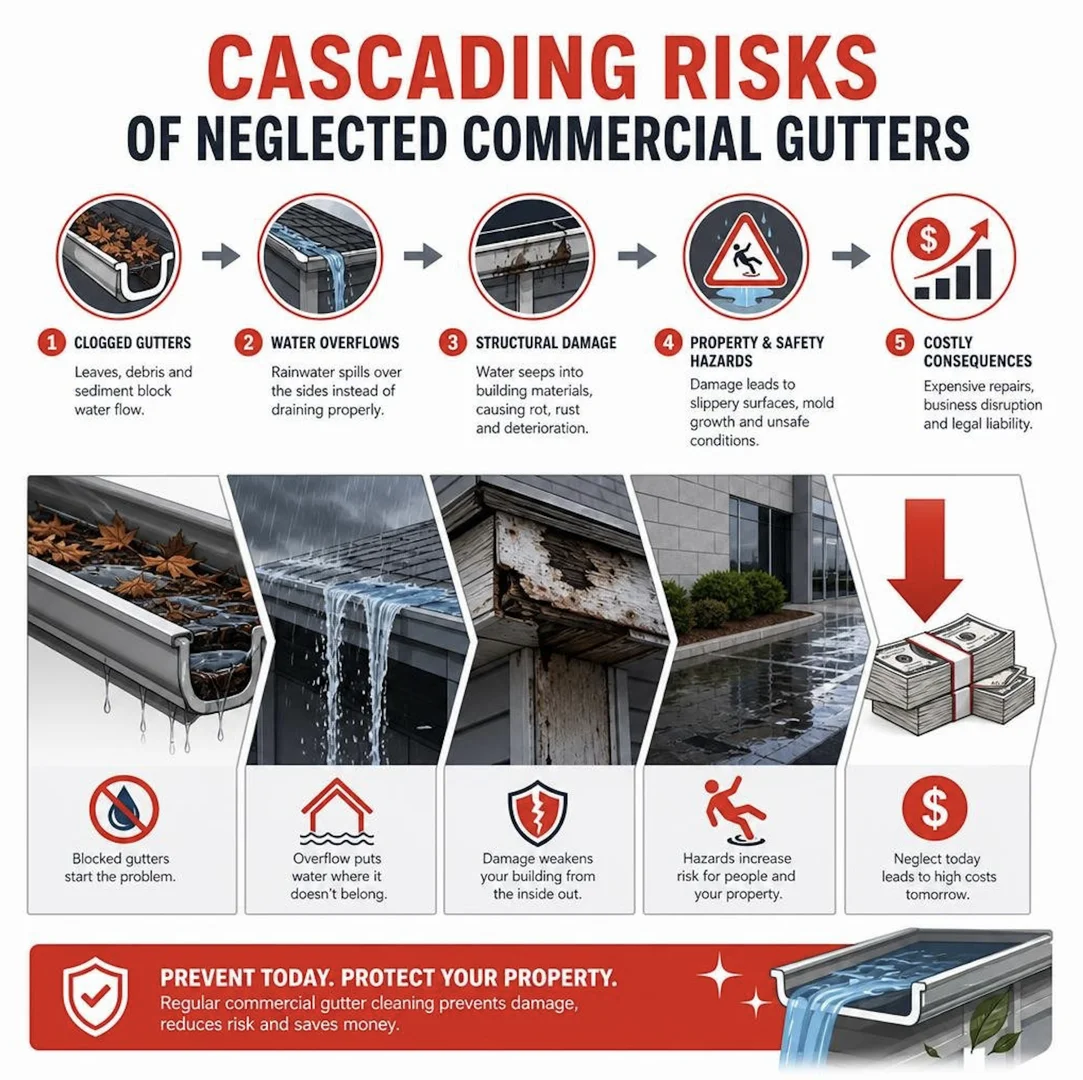
The Cost of Neglect vs. Preventative Maintenance
Taking a reactive approach to commercial gutter maintenance—waiting until you see water cascading like a waterfall over your entrance—is always more expensive than a proactive, planned preventative maintenance schedule.
Replacing rotted fascia boards can cost anywhere from $6 to $20 per linear foot, and a full eaves repair project on a commercial building can easily reach $6,800 if water has seeped deep into the structural wood.
By investing in regular cleanings, you protect your building’s exterior envelope. Siding, stucco, and brick masonry are highly susceptible to water staining, cracking, and spalling when constantly battered by overflowing water.
Regular cleanings keep water in its designated channels, preserving your property’s curb appeal and structural integrity.
Perhaps most importantly, preventative maintenance keeps your business running smoothly. You avoid the headache of tenant complaints in multi-family complexes, protect inventory in retail spaces from roof leaks, and prevent operational disruptions that occur when entrances are blocked by water or ice.
How Much Does Commercial Gutter Cleaning Cost in 2026?
Understanding how commercial gutter cleaning is priced helps property managers and HOA boards budget accurately and avoid unexpected surprises.
In 2026, commercial gutter cleaning costs between $0.90 and $2.75 per linear foot for multi-unit properties, HOAs, and business facilities.
| Property Type | Average Linear Footage | Service Frequency | Est. Cost Per Linear Foot (2026) | Est. Total Cost Per Service |
|---|---|---|---|---|
| Small Retail / Office (Single-Story) | 150 – 300 LF | Bi-Annual | $1.50 – $2.25 | $275 – $675 |
| Multi-Family HOA (12-24 Units) | 1,200 – 2,500 LF | Bi-Annual | $1.10 – $1.65 | $1,320 – $4,125 |
| Large Industrial Warehouse | 2,000 – 4,000+ LF | Annual / Bi-Annual | $0.90 – $1.40 | $1,800 – $5,600 |
| Multi-Story Office Park | 500 – 1,500 LF | Quarterly / Bi-Annual | $1.75 – $2.75 | $875 – $4,125 |
These commercial rates are structured differently than residential single-family rates. A typical single-family home ranges from $218 to $470 per cleaning, depending on size and height.
Because commercial properties feature much longer, continuous runs of guttering, they benefit from significant economies of scale.
Multi-unit properties and HOAs receive volume discounts that reduce per-unit pricing by 25% to 40% compared to individual residential rates. For larger associations with 24 or more units, tiered volume discounts can reach up to 50% off standard rates when bundled under a single service contract.
To secure these rates and lock in your maintenance budget, property managers can use G Home’s commercial services program, which provides predictable pricing and priority scheduling for larger facilities, HOAs, and multi-building properties.
While linear footage is the baseline for pricing, several factors can increase the cost of a commercial service:
- Multi-Story Building Premiums: Working at height requires specialized safety protocols and equipment. Second-story gutter systems typically add a 25% premium to the base rate, while third-story and higher access requires a 50% premium.
- Restricted Access Equipment Fees: If a building’s layout prevents ground-based cleaning or standard ladder setups, we may need to utilize specialized access equipment. Renting and operating articulating boom lifts or scissor lifts can add $75 to $200 per day to the project cost.
- After-Hours Service Premiums: For busy retail centers, medical clinics, or office parks where daytime maintenance would disrupt operations, scheduling services overnight or on weekends triggers a 30% to 40% premium.
- Certificate of Insurance (COI) Fees: Commercial properties require strict insurance documentation. Verifying and processing custom COIs naming the property manager or HOA as an additional insured can add a nominal fee of $75 to $125 annually to contract pricing to cover administrative overhead.
- Underground Drain Augering: If the blockage extends past the downspout into the underground drainage lines, specialized augering or high-pressure jetting is required to clear the line, which typically costs between $150 and $370 depending on the severity of the clog.
If you are managing properties across Middle Tennessee, understanding how local service delivery is organized can help you plan, though G Home prides itself on offering the most transparent, all-inclusive pricing in the region.
Understanding Commercial Pricing Factors
When we build a custom quote for your commercial property, we look at three primary variables:
- Linear Footage and Building Height: The physical size of the gutter system and how many stories up it sits. Higher gutters require more setup time, strict safety rigging, and slower, more deliberate movement.
- Debris Type and Density: Gutters filled with dry hardwood leaves are much faster to clean than gutters packed with heavy, wet pine needles, decomposing organic sludge, or industrial dust and grit from nearby manufacturing.
- Access Challenges: Landscaping, tight zero-lot-line alleys, parking configurations, and pedestrian walkways all impact how our crews access the gutters. Clear, wide-open perimeters are faster to service than tight, restricted spaces.
What Types of Commercial Properties Benefit Most from Professional Maintenance?
Different commercial properties face distinct water management challenges. A one-size-fits-all approach does not work when managing diverse real estate portfolios. Here is how professional maintenance benefits specific property types across our service areas:
HOA and Multi-Family Communities
Managing gutters for townhomes, condominiums, and apartment complexes in areas like Smyrna, Nolensville, and Franklin is a major coordination effort. HOA boards and property managers must balance resident expectations, minimize disruption, and justify how assessment dollars are spent.
For properties in Williamson County, G Home also provides localized commercial services in Franklin TN that help managers coordinate multi-building schedules, provide clear timelines for residents, and ensure crews work efficiently building-by-building.
Our volume discount structures are specifically designed for associations, allowing communities to keep their long-term reserve funds healthy while ensuring every unit is protected from water intrusion.
Industrial and Warehouse Facilities
Industrial buildings and warehouses typically feature massive, flat rooflines that drain into oversized gutter systems, often 6-inch, 7-inch, or 8-inch commercial box gutters. These systems are designed to handle immense water flow, but they also accumulate heavy debris.
In industrial zones, gutters don’t just collect leaves; they accumulate heavy dust, grit, and even industrial waste like sawdust or chemical particulates from surrounding operations.
Cleaning these systems requires high-capacity debris extraction and high-volume downspout flushing to ensure the vertical drops are completely clear.
Retail Centers and Strip Malls
For retail properties, curb appeal and safety are directly tied to your bottom line. Overflowing gutters create unsightly water stains on your building’s facade, wash away expensive landscaping mulch, and create customer-facing leaks right over store entrances.
Even worse, water pooling on walkways during a summer downpour or freezing into ice patches in the winter creates massive slip-and-fall liabilities.
We schedule retail cleanings during off-peak hours to ensure our trucks and equipment never block customer parking or disrupt daily business operations.
Medical Clinics and Schools
Healthcare facilities, senior living communities, and schools require a highly sensitive approach to maintenance. Noise, heavy machinery, and blocked access points can disrupt patient care or compromise student safety.
Our commercial crews utilize low-disruption, quiet cleaning methods, such as ground-level vacuum systems, and schedule work during weekends, school breaks, or early morning hours to ensure zero impact on daily operations.
How Often Should Commercial Gutters Be Cleaned?
As a standard rule of thumb, commercial gutters should be cleaned 2 to 4 times per year. However, the ideal frequency for your specific property depends heavily on your surrounding tree canopy, roof design, and regional weather patterns.
Here in Middle Tennessee, our climate presents unique challenges that accelerate gutter clogging:
- Heavy Spring Storms: The transition from winter to spring brings intense rainfall that can quickly overwhelm partially clogged gutters.
- Deciduous Foliage: Our region is home to dense stands of oak, maple, and hickory trees. In the spring, these trees drop massive amounts of pollen, seed pods, and maple “helicopters.” In the fall, they drop a heavy blanket of leaves.
- Rapid Organic Growth: Our hot, humid summers create the perfect environment for algae, mold, and moss to grow inside damp, shaded gutters, binding loose debris into a thick, solid mat.
To keep your system functioning perfectly year-round, schedule regular gutter cleaning before seasonal debris has time to compact, block downspouts, and send water back toward the roofline or foundation.
For properties with heavy tree cover or recurring clogs, gutter protection can reduce how often debris reaches the gutter channel while still allowing water to move through the system.
The G Home blog also offers practical maintenance guidance for owners comparing cleaning schedules, gutter protection options, and related exterior services before budgeting for the year.
Seasonal Maintenance Timelines
To stay ahead of the weather, structure your commercial gutter maintenance around these key seasonal windows:
- Spring Cleaning (April – May): Focuses on clearing out oak tassels, maple seed pods, pollen buildup, and winter debris to prepare your system for heavy summer thunderstorms.
- Late Fall Cleaning (November – December): Scheduled after the final leaf drop to ensure gutters are completely clear of fall foliage before freezing temperatures arrive.
- Winter Prep (January): Essential for checking downspouts and clearing any late-season debris to prevent standing water from freezing and creating destructive ice dams.
Signs Your Gutters Need Immediate Attention
Do not wait for your scheduled service if you notice any of the following warning signs:
- Visible Sagging: Gutters pulling away from the fascia board, indicating they are overloaded with heavy, wet debris.
- Water Cascading: Water spilling over the sides of the gutters during moderate rainfall, indicating a major clog in the run or downspout.
- Stained Siding or Masonry: Dark water stains running down your building’s exterior walls.
- Foundation Pooling: Water pooling or soil eroding directly beneath the roofline.
- Plant Growth: Grass, weeds, or moss visibly growing out of the gutter channel.
What Equipment and Methods Do Professionals Use to Clean Commercial Gutters?
The days of commercial gutter cleaning relying solely on a worker climbing a shaky ladder with a bucket and a plastic scoop are long gone. While traditional methods still have their place in specific scenarios, modern commercial maintenance utilizes advanced technology to improve safety, efficiency, and cleaning quality.
Ground-Level Vacuum Technology
One of the most significant advancements in commercial exterior maintenance is the introduction of high-reach, ground-level vacuum systems.
These systems utilize ultra-lightweight carbon fiber poles connected to industrial-grade cyclone vacuums. This setup allows our technicians to safely and thoroughly clean commercial gutters up to 40 feet high (approximately three stories) while keeping their feet firmly on the ground.
This method offers massive advantages for commercial property managers:
- Zero Tenant Disruption: There are no loud, heavy boom lifts blocking parking spaces, driving over sidewalks, or idling outside office windows.
- Roof Protection: Many commercial buildings feature metal roofs (standing seam, corrugated, or ribbed). Walking on these roofs or leaning heavy ladders against them can scratch the protective paint and sealant layers, exposing the bare metal to moisture, which leads to rust and leaks. Ground-level cleaning completely eliminates this risk.
- Eliminating Fall Liabilities: Falls are the leading cause of injury in the exterior maintenance industry. Keeping technicians on the ground eliminates this liability entirely for property owners and managers.
High-Volume Flushing and Downspout Testing
Removing the large debris is only the first step. To ensure a commercial gutter system is truly functional, we perform a high-volume system flush.
Using professional-grade hoses, we run water through the entire gutter run to wash away fine silt, sand, and organic particulates that vacuums or blowers leave behind.
During the flush, we test every downspout and scupper to verify 100% flow capacity. If we discover a blockage in a vertical drop or an underground drainage connection, we utilize specialized drain snakes or high-pressure water jetting to clear the line.
Traditional Access Equipment
While ground-level vacuums are our preferred method, some commercial properties feature unique architectural designs, extreme heights, or heavy debris loads that require traditional access.
In these cases, our crews are fully trained and certified to operate specialized equipment, including:
- Articulating Boom Lifts (Cherry Pickers): To safely reach high, awkward angles over landscaping or structural obstacles.
- Scissor Lifts: Ideal for long, straight runs on multi-story buildings with flat, paved perimeters.
- OSHA-Compliant Ladder Systems: Utilizing specialized ladder stand-offs and stabilizers to protect your building’s gutters and siding from weight damage.
How Do You Choose and Vet a Reliable Commercial Gutter Contractor?
Hiring a contractor to work on a commercial property or HOA community involves managing significant legal and financial risks. If an unvetted, underinsured contractor is injured on your property, your business or association can be held liable for millions of dollars in damages.
To protect your organization, use this checklist when vetting any commercial gutter cleaning provider:
- Verify General Liability Insurance: Ensure the contractor carries a minimum of $1 million per-occurrence and $2 million aggregate in general liability insurance specifically rated for high-reach commercial work.
- Verify Workers’ Compensation: Never hire a company that cannot provide proof of active workers’ compensation insurance for every technician on-site.
- Inquire About Employee Status: Ask if the crew consists of W-2 in-house employees or 1099 subcontractors. In-house employees undergo consistent safety training, are directly covered by the company’s insurance, and are held to strict quality standards. Subcontractors often lack this level of oversight.
- Understand the Legal Precedents: In the landmark case Heiman v. Workers’ Comp Appeals Board, the court established that HOA boards and property managers can be held directly liable for injuries to unlicensed or underinsured contractors working on association property.
To ensure your property is fully protected, we always recommend pairing professional cleaning with long-term preventative upgrades.
If our crews identify structural issues during a cleaning, G Home can perform immediate gutter installation and gutter repairs to keep your system in peak condition.
Digital Documentation and Reporting
A professional commercial contractor should provide transparent, verifiable proof of their work. Because you cannot easily climb a three-story roof to inspect the gutters yourself, we provide comprehensive Digital Completion Reports with every service.
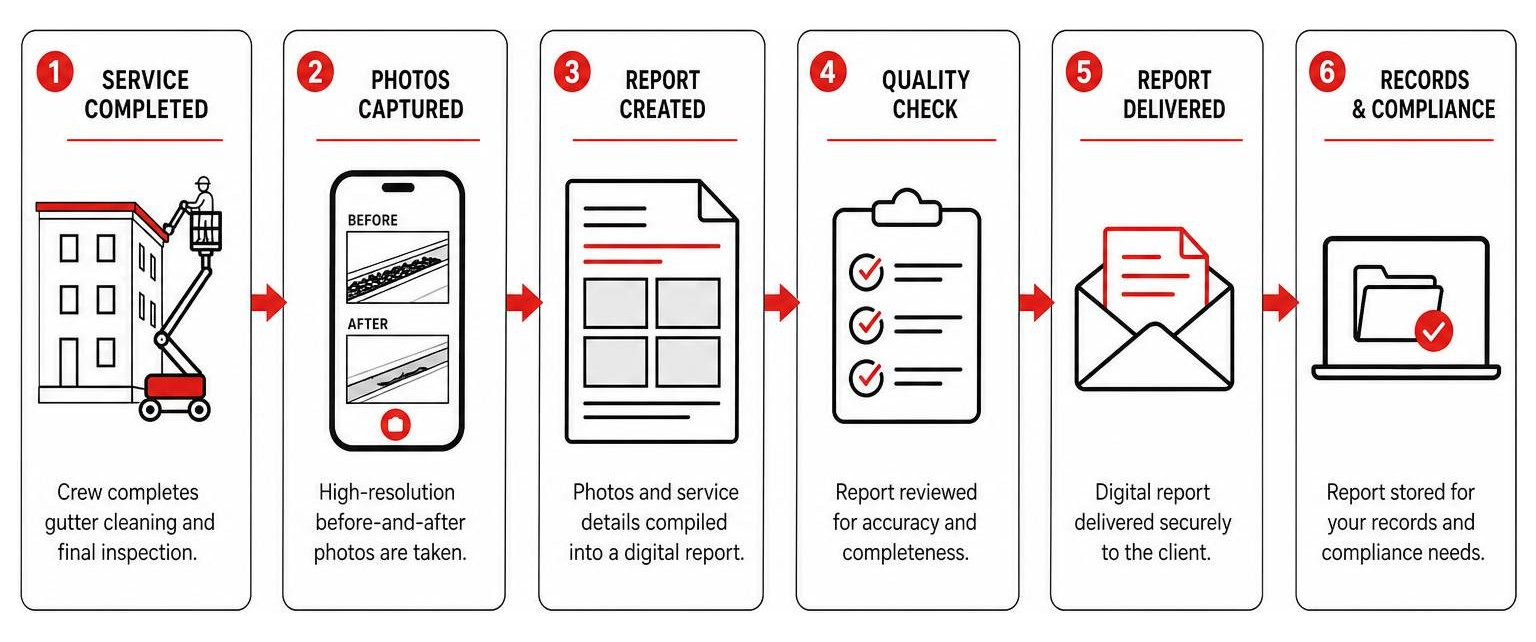
These reports include high-resolution before-and-after photographs of your gutters, downspouts, and roofline.
This documentation serves as official proof of maintenance for your insurance carriers, helps justify assessment expenditures to HOA boards, and provides a clear record of your building’s exterior health.
Frequently Asked Questions About Commercial Gutter Cleaning?
Do commercial gutter cleaning contracts require multi-year commitments?
No. Most professional commercial gutter cleaning contracts operate on a flexible, annual renewal basis. This structure allows property managers to lock in their service rates for 12 months—protecting their budget from inflation and labor cost increases—without being locked into a long-term, multi-year commitment.
At G Home, we offer “set-it-and-forget-it” annual maintenance plans that automatically schedule your cleanings during peak spring and fall seasons, ensuring your property is always protected.
Can clogged gutters cause mold and structural damage inside a commercial building?
Yes, absolutely. When gutters clog, water backs up under the roofline and seeps into the wooden fascia boards, soffits, and roof decking. Over time, this moisture migrates into the building’s interior walls and ceilings, leading to extensive drywall damage and toxic mold growth.
Additionally, water overflowing from clogged gutters pools at the foundation, where it can seep through concrete pores and flood basements, crawlspaces, or ground-floor office suites.
Resolving these moisture issues and repairing structural wood rot or cracked foundations can easily exceed $10,000.
What are the benefits of installing commercial gutter guards?
Installing commercial-grade gutter guards is one of the smartest long-term investments a property manager can make. Gutter guards act as a physical barrier, allowing water to flow freely into the channel while keeping out leaves, twigs, pine needles, and large debris.
The primary benefits include:
- Reduced Cleaning Frequency: Cuts your required professional cleanings down significantly, saving thousands of dollars in annual maintenance costs.
- Extended System Lifespan: Prevents the heavy weight of wet debris from warping or pulling your gutters loose, and stops wet organic matter from causing premature rust and corrosion.
- Pest Prevention: Eliminates the standing water and decomposing organic material that attracts mosquitoes, birds, rodents, and stinging insects.
How Can G Home Help Protect Your Commercial Property?
Maintaining a commercial property requires balancing long-term structural integrity with strict budgetary limits. Clogged gutters are more than just an eyesore; they are a direct threat to your building’s foundation, roofline, and financial bottom line.
Fortunately, these risks are entirely preventable. By partnering with a fully licensed, insured, and experienced exterior maintenance provider, you can protect your real estate assets and keep your business running smoothly.
At G Home, we deliver stress-free, professional commercial gutter cleaning, gutter protection, and exterior soft washing services tailored specifically for the unique climate challenges of Middle Tennessee.
With over 25 years of local industry experience, we understand what it takes to manage water runoff safely and efficiently for commercial properties, HOA communities, and multi-family complexes in Smyrna, Nolensville, Nashville, Franklin, Brentwood, Hendersonville, and Murfreesboro.
When you partner with us, you get:
- Fully Insured, W-2 Crews: Our full-time technicians trained in strict OSHA safety standards, backed by comprehensive commercial liability and workers’ compensation insurance.
- Ground-Level Vacuum Technology: Safe, quiet, and highly efficient cleaning that protects your building’s metal roofs and causes zero disruption to your tenants or customers.
- Digital Completion Reports: Transparent, high-resolution before-and-after photo documentation delivered straight to your inbox.
- All-Inclusive Exterior Care: A single, trusted provider for gutter cleaning, professional-grade gutter protection, and gentle exterior soft washing to maximize your property’s curb appeal.
Don’t wait for the next heavy Middle Tennessee storm to find out if your gutters are clogged. Contact our professional commercial gutter cleaning technicians today to request a custom, hassle-free quote for your property.