Commercial Property Repairs and Maintenance: A Complete Management Guide
The Real Cost of Ignoring Commercial Property Repairs and Maintenance
Commercial property repairs and maintenance covers every task needed to keep a business building safe, functional, and in good shape, from HVAC servicing and roof inspections to gutter cleaning and lease compliance.
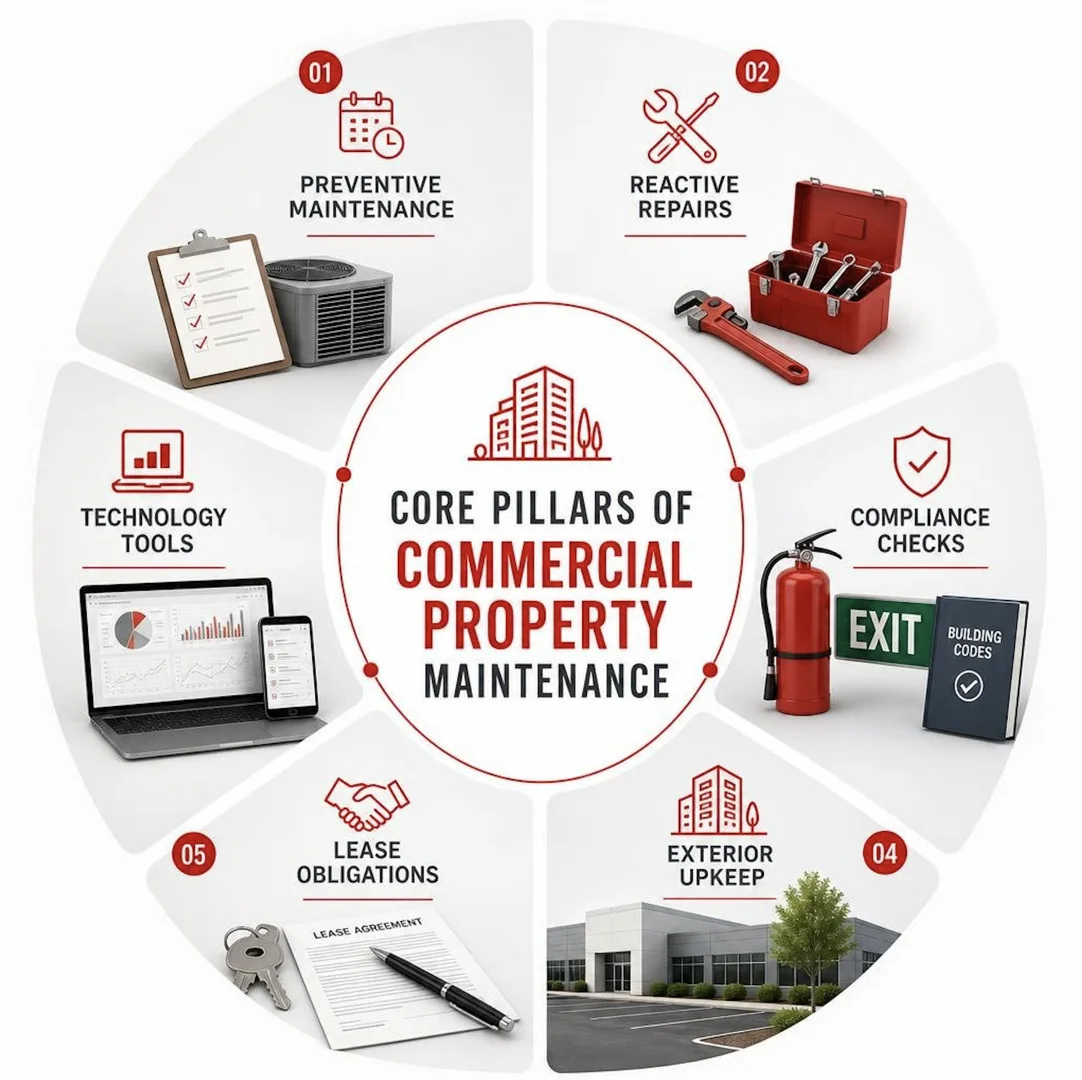
Here’s a quick-reference overview of what it involves:
| Category | What It Covers |
|---|---|
| Preventive maintenance | Scheduled inspections, filter changes, roof checks, gutter cleaning |
| Reactive repairs | Fixing burst pipes, electrical faults, broken HVAC units |
| Compliance checks | Fire safety, ADA requirements, building codes |
| Exterior upkeep | Soft washing, pressure washing, parking lot maintenance |
| Lease obligations | Landlord vs. tenant repair responsibilities, CAM charges |
| Technology tools | CMMS platforms, IoT sensors, predictive analytics |
Imagine arriving at your business on a cold winter morning to find water everywhere from a burst pipe, and then discovering your lease makes you responsible for every penny of the damage. That scenario plays out more often than most property owners or tenants expect.
The truth is, most commercial building problems don’t appear overnight. They build slowly, a clogged gutter here, a neglected HVAC filter there, until a minor issue becomes a major bill. A structured maintenance approach prevents that cycle before it starts.
What is Commercial Property Maintenance and Why Does It Matter?
At its core, commercial property maintenance is the strategic, ongoing upkeep of a building’s physical structure and mechanical systems. Unlike residential maintenance, which often deals with single-family scales, commercial upkeep must support heavy daily foot traffic, complex building systems, and strict regulatory standards.
When you neglect your property, the consequences ripple far beyond a peeling coat of paint. Consistent maintenance serves several critical business goals:
- Asset Preservation: Your physical property is one of your most valuable business assets. Regular upkeep halts deterioration and extends the lifespan of expensive building components.
- Revenue Stream Consistency: In multifamily and other income-producing properties, fast, high-quality maintenance directly protects occupancy, rent collection, and renewal momentum. Quick turns after move-outs, prompt exterior repairs, and reliable vendor response times reduce the risk of units or commercial spaces sitting offline longer than necessary.
- Tenant Retention and Satisfaction: If you lease your building, your tenants expect a safe, clean, and comfortable environment. Broken elevators, leaky roofs, or drafty HVAC systems will quickly drive high-quality tenants to look for space elsewhere.
- Risk Mitigation and Safety: Slips, trips, and falls on cracked sidewalks, or mold outbreaks from poor exterior drainage, expose you to massive legal liabilities.
- Curb Appeal and Brand Image: A well-presented exterior builds instant trust. It projects professionalism and tells clients, employees, and visitors that you care about quality.
For multifamily operators especially, maintenance speed and workmanship quality are tied directly to missed-revenue risk. A slow gutter repair, unresolved drainage problem, stained exterior, or delayed unit-turn task can extend vacancy periods, weaken leasing confidence, and create avoidable concessions. A disciplined maintenance process keeps properties rent-ready, protects resident satisfaction, and helps owners preserve predictable income instead of losing days or weeks to preventable downtime.
Whether you are expanding a commercial portfolio in Smyrna, TN or managing an established location in Nashville, keeping a firm grip on your building’s physical health is non-negotiable.
Core Systems in Commercial Property Repairs and Maintenance
A commercial building is a network of interconnected systems, each requiring specialized attention. When one system fails, it often triggers a domino effect across the others.
- HVAC Systems: Commercial heating, ventilation, and air conditioning units are massive, roof-mounted systems that control indoor air quality and climate. In Middle Tennessee, where summers are sweltering and winters bring freezing snaps, a sudden breakdown can force a complete business shutdown.
- Electrical Grids: From interior lighting and office workstations to exterior security systems and illuminated signage, your electrical infrastructure must remain up to code to prevent fire hazards.
- Plumbing Infrastructure: This includes commercial restrooms, break rooms, and complex backflow prevention assemblies. Ensuring professional installation and routine checks prevents catastrophic leaks.
- Roofing and Exteriors: Flat or low-slope commercial roofs are highly vulnerable to ponding water and weather damage. Protecting this barrier is vital to keeping the rest of the building dry and structurally sound.
To keep these systems humming, many owners rely on comprehensive commercial services from G Home for exterior protective care such as gutter cleaning, gutter protection installation, and low-pressure soft washing. Pairing those services with a regular inspection schedule helps reduce roof-edge leaks, drainage issues, stained exterior surfaces, and other preventable problems that can affect daily operations and curb appeal.
The 6 Types of Commercial Property Repairs and Maintenance
To manage a commercial building effectively, you must understand the different approaches to keeping it in peak condition. Most maintenance tasks fall into one of these six categories:
- Preventive Maintenance (PM): Scheduled, proactive servicing designed to prevent equipment failures before they happen. Examples include replacing air filters, lubricating bearings, and cleaning gutters.
- Reactive Repairs: Also known as “run-to-failure” maintenance. This is the work done to fix equipment that has already broken down (e.g., repairing a shattered window or fixing a burst pipe).
- Predictive Maintenance: A high-tech approach that uses real-time data from building sensors to predict exactly when a component will fail, allowing you to service it just in time.
- Corrective Actions: Addressing a minor fault discovered during routine inspections before it can cause a total system breakdown (e.g., replacing a worn belt on a fan motor before the belt snaps).
- Deferred Maintenance: Maintenance tasks that are postponed due to budget limits or lack of resources. While sometimes necessary, letting deferred tasks pile up creates a backlog that leads to massive emergency expenses later.
- Compliance-Driven Checks: Mandatory inspections required by local or national laws, such as elevator certifications, fire alarm testing, and ADA accessibility audits.
| Maintenance Type | Approach | Cost Structure | Risk Level |
|---|---|---|---|
| Preventive | Proactive / Scheduled | Predictable, low-to-moderate | Very Low |
| Reactive | Emergency / As-Needed | Unpredictable, high | Extremely High |
| Predictive | Data-Driven / Real-Time | Moderate setup, highly efficient | Low |
| Corrective | Early Intervention | Low-to-moderate | Low |
| Deferred | Postponed / Backlogged | Low short-term, massive long-term | High |
| Compliance | Legal / Mandatory | Fixed | Low (avoids legal fines) |
Why Preventive is More Cost-Effective Than Reactive Maintenance
It is easy to fall into the trap of thinking, “If it isn’t broken, don’t fix it.” However, in the commercial real estate world, reactive maintenance is a financial black hole.
Consider the hard data. A landmark study by Jones Lang LaSalle (JLL) covering 14 million square feet of commercial space revealed that structured HVAC preventive maintenance delivered a staggering 500% ROI. By spending a small, predictable amount on routine inspections and filter changes, property teams avoided catastrophic compressor failures and extended the overall life of their units.
Furthermore, peer-reviewed research by Kwak et al. demonstrated that condition-based preventive and predictive maintenance increased equipment uptime by 90 to 175 hours in high-rise office buildings.
When you shift from reactive to preventive care, you gain control over your budget. You can schedule repairs during off-hours to avoid disrupting tenants, negotiate better rates with vendors, and source parts without paying overnight shipping fees. For exterior upkeep, scheduling routine gutter and soft washing service with a reputable commercial property maintenance provider can keep your operations running smoothly.
Structuring Your Commercial Property Maintenance Schedule
An effective maintenance plan relies on a clear, organized schedule. Without one, tasks slip through the cracks, leading to premature wear and tear.
In Middle Tennessee, from the commercial hubs of Nashville to the expanding developments in Nolensville, our local climate brings unique challenges. High humidity, heavy spring rainfall, and rapid freeze-thaw cycles in winter put extreme stress on commercial exteriors. For example, maintaining beautiful commercial green spaces requires local expertise to handle seasonal transitions safely.
Daily, Weekly, and Monthly Upkeep Tasks
Short-term tasks focus on safety, cleanliness, and minor adjustments. They keep your building presentable and stop small issues from snowballing.
- Daily: Emptying waste bins, sweeping entryways, sanitizing high-touch surfaces, and checking that all exit doors are clear and functioning.
- Weekly: Inspecting interior and exterior lighting (replacing burnt-out bulbs), checking plumbing fixtures for slow leaks, and clearing debris from walkways.
- Monthly: Testing emergency exit signs and backup lights, inspecting fire extinguishers, checking HVAC filters, and walking the property line to remove trash or graffiti.
If you don’t have an on-site team to handle these tasks, outsourcing to professional commercial handyman services can keep your space immaculate. Utilizing experienced technicians provides access to help with patching drywall, realigning heavy commercial doors, and replacing damaged ceiling tiles.
Quarterly and Annual Commercial Property Repairs and Maintenance
Longer-term tasks focus on major building systems and structural integrity. These tasks require deeper planning and often involve specialized contractors.
- Quarterly: Testing backflow preventers, servicing HVAC compressors, checking roof drainage paths, and inspecting parking lot surfaces for potholes.
- Annual: Comprehensive roof inspections, checking structural foundations, testing fire sprinkler systems, and professional exterior cleaning.
In Middle Tennessee, commercial gutter systems require deep seasonal cleaning to prevent water from backing up under the roofline. Booking commercial services in Franklin, TN with G Home before heavy spring storms helps protect the roof edge, siding, walkways, and storefront appearance through the wettest part of the year.
Navigating Lease Obligations: Who Pays for What?
One of the biggest friction points in commercial real estate is determining who is responsible for repairs: the landlord or the tenant. Unlike residential leases, which heavily protect the tenant, commercial leases are highly negotiable and vary wildly.
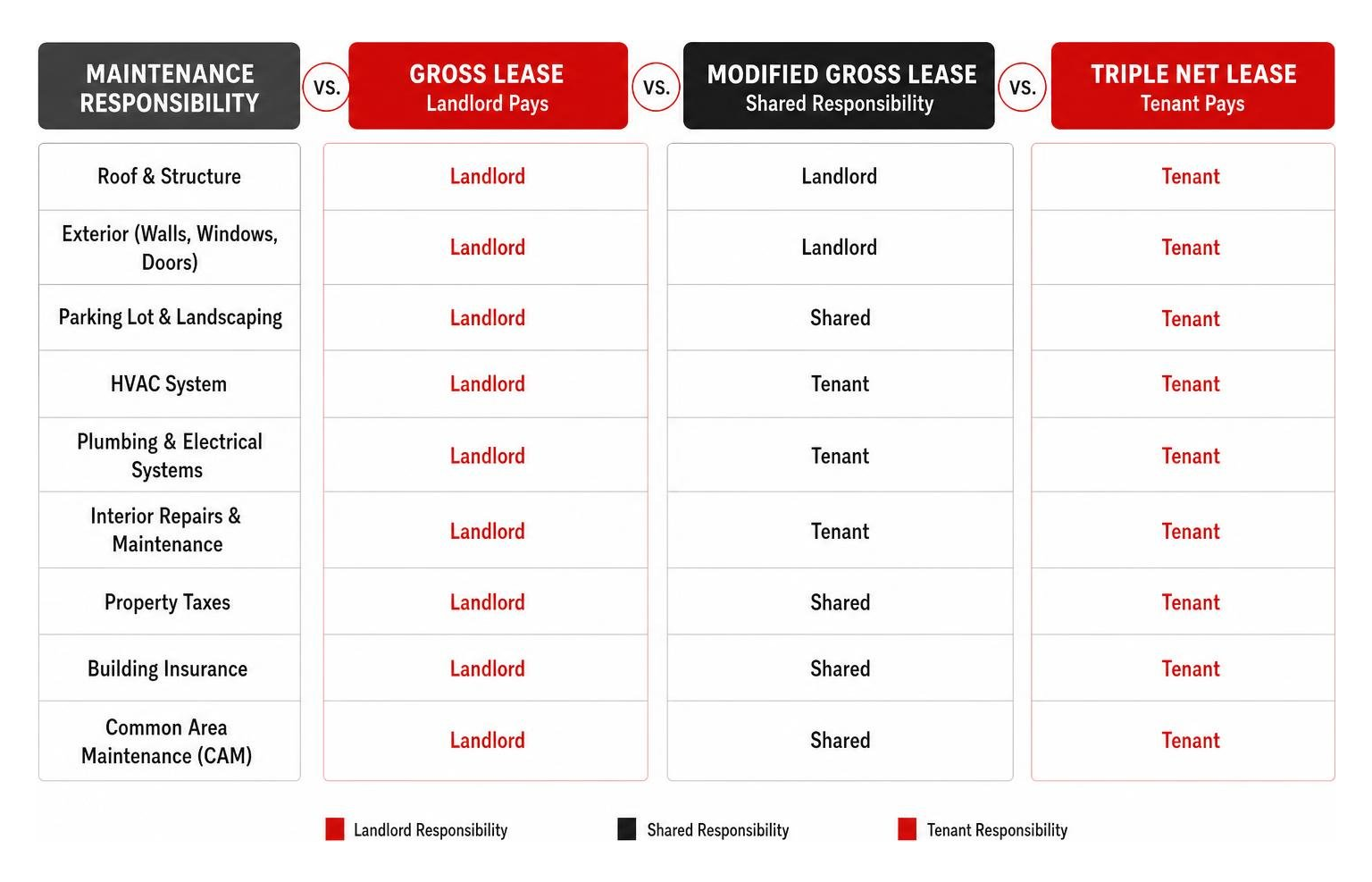
The division of maintenance costs depends entirely on the lease structure:
- Triple Net (NNN) Leases: This is the most common structure for standalone commercial buildings. The tenant pays a base rent plus their proportional share of property taxes, building insurance, and Common Area Maintenance (CAM) fees. Under a true NNN lease, the tenant is often responsible for almost all maintenance, including the HVAC and interior systems.
- Gross Leases: The tenant pays a flat monthly rate, and the landlord covers all property taxes, insurance, and maintenance costs.
- Modified Gross Leases: A compromise where the landlord and tenant agree to split specific maintenance obligations. For example, the landlord might maintain the roof and structure, while the tenant handles the interior HVAC and plumbing.
Before signing any agreement, it is critical to negotiate the repairs and maintenance clause. Ensure the lease clearly defines what constitutes a “repair” versus a “replacement” (especially for high-cost items like the HVAC), and verify how CAM charges are calculated to avoid unexpected bills.
Tenant Risks and Dilapidations at Lease End
Tenants face significant financial risks if they fail to maintain their leased space. At the end of a lease term, landlords will often conduct a thorough inspection to ensure the property is returned in good condition.
- Schedule of Condition: This is a vital document prepared at the start of a lease to record the exact state of the building. Without a photographic Schedule of Condition, a tenant can be held liable for fixing defects that existed before they even moved in.
- Terminal Dilapidations: This is a legal claim served by the landlord at lease end, demanding that the tenant pay for any outstanding repairs or alterations needed to restore the space to its original state.
- The Trap of “Keep in Good Condition”: Legally, a covenant to “keep in good condition” is much more demanding than a covenant to “repair.” If a tenant agrees to keep a system in good condition, they may be legally forced to replace an aging system entirely, even if it was near the end of its useful life when they moved in.
To protect yourself from costly legal disputes, always consult a commercial real estate attorney to review repair covenants and identify potential latent defects before signing.
Leveraging Technology for Modern Facility Management
The days of tracking building repairs on paper clipboards or messy spreadsheets are over. Modern property managers rely on technology to streamline workflows, cut costs, and improve communication.
- Computerized Maintenance Management Systems (CMMS): Platforms like CMMS allow property teams to log maintenance requests, track work orders, manage vendor contracts, and maintain a digital history of all repairs. This central database is invaluable for spotting patterns and planning capital expenditures.
- Building Analytics and IoT Sensors: Smart sensors placed on critical equipment can monitor temperature, vibration, and energy usage in real-time. If an HVAC unit starts drawing too much power or vibrating abnormally, the system flags it immediately, allowing technicians to intervene before a total breakdown occurs.
- AI Task Routing: Advanced property management software can automatically route repair requests to the right technician based on their location, trade specialty, and current workload, drastically reducing response times.
By integrating these smart tools, commercial operations can transition to highly efficient, predictive workflows. Partnering with professional facility maintenance contractors or working with a tech-forward commercial building maintenance company ensures you have the data and resources needed to manage complex portfolios without losing your mind.
Technology helps with scheduling, documentation, and work-order visibility, but it cannot replace proven seasonal maintenance habits. In Middle Tennessee, exterior issues often start quietly, with leaves collecting in commercial gutters, roof runoff backing up near fascia boards, or drainage problems sending water toward walkways and foundations. G Home explains the role of routine drainage care in its guide to gutter cleaning services, which is especially relevant for property managers trying to reduce roof-edge leaks, overflow, and moisture-related damage.
Exterior surfaces need the same kind of planned attention. Humidity, shade, pollen, and storm residue can leave siding, storefronts, awnings, and walkways looking neglected while also creating slip hazards or surface deterioration. For buildings with visible algae, mildew, or grime, G Home outlines how low-pressure cleaning works in its guide to soft washing services, making it a practical addition to a preventive maintenance calendar before the FAQ section of this plan.
Frequently Asked Questions about Commercial Upkeep
How often should commercial properties undergo exterior soft washing?
In Middle Tennessee, commercial buildings should be professionally soft washed at least once or twice a year. Our regional humidity, heavy seasonal pollen, and damp winters create the perfect breeding ground for organic contaminants like mold, mildew, and black algae.
Unlike high-pressure washing, which can strip paint, damage delicate commercial awnings, and crack siding, soft washing uses low-pressure water combined with specialized, biodegradable detergents. This process kills organic growth at the root, preserving your building materials, restoring curb appeal, and keeping walkways slip-free to eliminate liability risks.
What are the consequences of deferring commercial property repairs?
Deferring maintenance might save you a few dollars today, but it is a massive financial risk. The primary consequences include:
- Accelerated Asset Depreciation: Minor roof leaks or clogged gutters quickly lead to rotted wood, structural mold, and foundation damage, wiping out your property’s market value.
- Code Violations and Legal Fines: Neglecting safety systems (like fire alarms or ADA-compliant ramps) can result in heavy government fines, forced closures, or devastating lawsuits.
- Skyrocketing Emergency Costs: Fixing a system after a catastrophic failure is often 5 to 10 times more expensive than performing routine preventive care.
How can landlords and tenants negotiate HVAC replacement responsibilities?
HVAC replacement is one of the most common sources of lease disputes. Because a commercial HVAC unit can cost tens of thousands of dollars, neither side wants to bear the full cost. Best practices for negotiating this include:
- Useful Life Amortization: If a new HVAC unit is required during the lease, the cost should be amortized over its useful life (typically 15 years). The tenant only pays for the portion of the useful life they actually consume during their lease term.
- Maintenance History Caps: Tenants can negotiate an annual cap on HVAC repair costs (e.g., the tenant pays for routine maintenance up to $1,500 per year, and the landlord covers anything beyond that).
- Pre-Lease Inspections: Always require a certified HVAC technician to inspect the system before signing, ensuring the landlord delivers the unit in perfect working order.
Conclusion
Managing commercial property repairs and maintenance doesn’t have to be a source of constant stress. By shifting from a reactive “fix-it-when-it-breaks” mindset to a structured, preventive plan, you protect your physical assets, keep your tenants happy, and maintain predictable operating budgets.
At G Home, we specialize in taking the hassle out of exterior building care. We provide professional, stress-free gutter cleaning, gutter protection installation, and low-pressure exterior soft washing tailored specifically for Middle Tennessee’s challenging climate. With over 25 years of experience serving businesses across Smyrna, Nolensville, Nashville, Franklin, Brentwood, Hendersonville, and Murfreesboro, we know exactly what it takes to keep your property looking pristine and structurally protected.
Don’t wait for a clogged gutter to cause a costly roof leak or for algae to ruin your building’s curb appeal. Contact our professional commercial exterior maintenance technicians to keep your business property in peak condition for years to come.