
Everything You Need to Know About Multi-Unit Dryer Vent Cleaning
The Critical Importance of Multi-Unit Dryer Vent Cleaning
Multi-unit dryer vent cleaning is the process of removing lint, debris, and blockages from dryer exhaust systems across apartment complexes, condominiums, townhomes, and other multi-family properties, and it’s one of the most important (and most overlooked) maintenance tasks a property manager can schedule.
Quick answer: Here’s what you need to know at a glance:
| Question | Answer |
|---|---|
| How often should multi-unit dryer vents be cleaned? | At least once per year; every 6 months for high-use buildings |
| Who is responsible? | Property owner or manager (not individual tenants) |
| Biggest risk of neglect? | Dryer fires, nearly 16,000 per year in the U.S. (NFPA) |
| Key warning signs? | Long drying times, burning smells, excessive heat, damp clothes |
| Are there legal requirements? | Yes, many fire codes and insurance policies require it |
Most people don’t think about what’s happening inside the walls of a multi-family building. Dryers run dozens, sometimes hundreds, of cycles every week. Lint builds up fast. And in a shared building, one clogged vent doesn’t just affect one unit. It puts the entire building at risk.
The difference between a single-family home and a multi-unit property isn’t just scale. It’s complexity. Shared duct systems, long vent runs, rooftop exits, and inconsistent tenant habits all make lint accumulation faster and harder to catch.
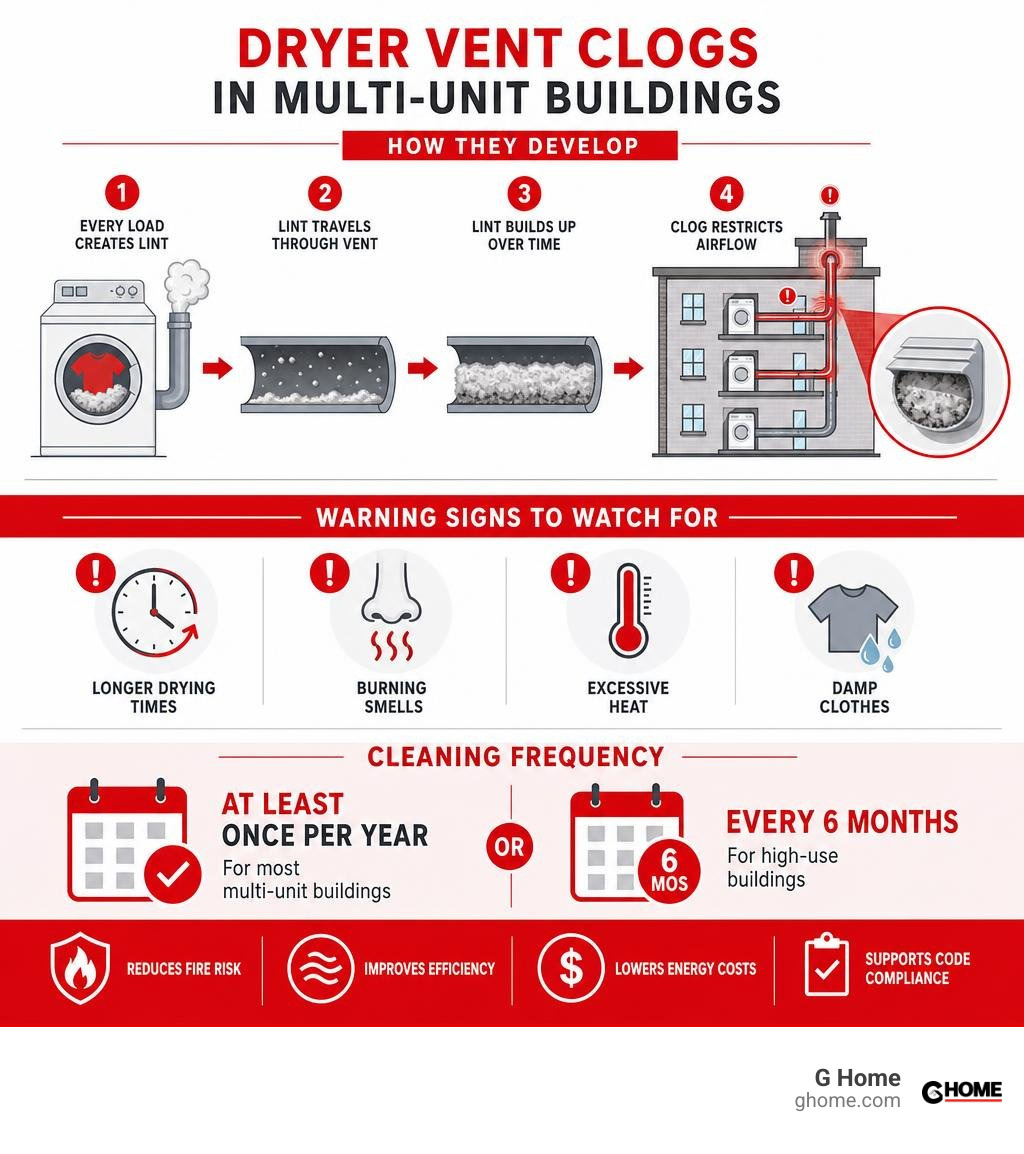
When you manage a residential complex in Middle Tennessee, you have a lot on your plate. From leaky pipes to tenant disputes, your to-do list is endless. However, what is happening deep within your building’s walls deserves your immediate attention.
In multi-family properties, dryer vent lines are often incredibly long and complex. They wind through shared walls, travel up vertical shafts, and exit through side walls or roof lines. Because these systems are out of sight, they are frequently out of mind. But neglecting them is a recipe for disaster.
According to the National Fire Protection Association (NFPA), dryers cause nearly 16,000 house fires each year. In a single-family home, a dryer fire is a tragedy. In an apartment complex or condominium building, it is a catastrophic multi-family emergency that can displace dozens of families in minutes.
Beyond fire safety, clogged vents trap moisture. In our humid Middle Tennessee climate, trapped humid air inside walls creates a perfect breeding ground for mold and mildew. This directly degrades indoor air quality and can trigger severe respiratory issues for your residents. To keep your residents healthy, maintaining clean ductwork is vital. Ensuring proper ventilation and regular maintenance can help ensure your building’s breathing air remains safe and fresh.
Understanding the Shared Fire and Safety Risks
Why are multi-unit buildings at such a high risk? The answer lies in the architecture. Unlike single-family homes where a dryer vent runs a few feet directly to an outside wall, multi-family systems often feature long, winding duct runs with multiple 90-degree bends.
Every bend is a catch-point for highly flammable lint. If a fire ignites in one unit’s dryer duct, the flames can rapidly feed on the accumulated lint inside the shared wall cavities. This turns the exhaust system into a superhighway for fire, carrying smoke, toxic gases, and flames directly to neighboring units.
Furthermore, blocked vents can cause backdrafts of carbon monoxide if gas dryers are in use. There is also the pest factor: birds, squirrels, and wasps love the warm, sheltered environment of an exhaust vent. During nesting season, they build nests that completely choke off airflow, escalating the fire hazard.
Improving Energy Efficiency and Reducing Operating Costs
Regular multi-unit dryer vent cleaning isn’t just a safety protocol; it is also an excellent way to keep your property’s operating costs down.
When lint restricts airflow, the dryer has to work twice as hard to push damp air out of the building. ENERGY STAR notes that improved dryer efficiency can lower energy use, which is one reason clear airflow matters for property operating costs. This leads to:
- Skyrocketing utility bills: Dryers run longer, consuming massive amounts of electricity or gas.
- Premature appliance failure: The extreme heat wears out heating elements, belts, and motors, forcing costly repairs or early replacements.
- Unhappy tenants: Nobody wants to run their towels through three drying cycles just to get them dry.
By investing in preventative maintenance, you improve your building’s overall energy footprint and extend the lifespan of the appliances, keeping both your accountant and your tenants happy.
Maintenance Responsibilities and Compliance Standards
A common question we hear in the property management world is: Whose job is it anyway?
While tenants are responsible for cleaning their individual dryer lint screens after every load, they cannot clean the actual duct system. They don’t have the tools, the access, or the training. The responsibility for maintaining the main duct system and ensuring local building and safety codes are met falls squarely on the property owner, landlord, or HOA board.
To protect your investment and keep your facility running smoothly, it is wise to partner with a professional team that understands commercial property dynamics. G Home structures large-scale projects through dedicated commercial services that help property managers plan access, documentation, and recurring maintenance without creating unnecessary tenant disruption.
Establishing a Multi-Unit Dryer Vent Cleaning Schedule
In 2026, safety standards and insurance guidelines are stricter than ever. To keep your property compliant and safe, you must establish a clear, recurring schedule.
- Standard Multi-Family Buildings: Vents should be professionally cleaned at least once every 12 months.
- High-Traffic or Shared Laundry Rooms: Buildings with shared laundry facilities or exceptionally heavy daily usage should schedule cleanings every 6 months.
- Complex Routing: Properties with long vertical shafts or roof-routed vents should be inspected every 6 to 9 months to prevent bird nesting and heavy lint buildup.
Always keep a detailed, centralized maintenance log. Tracking exactly when each line was inspected and cleaned protects you from liability and provides clear proof of due diligence.
Legal and Insurance Documentation Requirements
Did you know that many insurance carriers now mandate regular, documented dryer vent cleanings for multi-unit facilities? If a fire occurs and you cannot produce records showing professional maintenance, your insurance claim could be denied, leaving you with millions of dollars in liability.
Local fire departments and building inspectors also require proof of compliance during routine safety audits. When G Home performs cleanings, your property receives clear compliance certificates and system reports. For properties in Williamson County, our commercial services in Franklin, TN help local managers document completed work and stay prepared for inspections.
Warning Signs and System Upgrades for Property Managers
As a property manager, you don’t have to guess when your vents are clogged. Your tenants and your buildings will tell you if you know what to look for.
Key Signs Your Building Vents Need Immediate Attention
Keep a close eye out for these warning signs across your property:
- Tenant Complaints: Residents reporting that clothes are taking two or three cycles to dry.
- Excessive Heat: The laundry room or the exterior of the dryer feels unusually hot to the touch.
- Musty Odors: A damp, musty smell in the laundry area, indicating trapped moisture that can lead to mold.
- Visible Debris: Lint spilling out from the transition hose behind the dryer or visible blockages at the exterior wall terminal.
- No Airflow: Little to no air blowing out of the exterior exhaust vent while the dryer is running.
If you are managing properties in Davidson County, keeping up with these indicators is key to preventing emergencies. Residents can monitor their systems locally, but if problems persist, scheduling professional dryer vent cleaning is an excellent step toward restoring peak performance.
Recommended Vent Materials and Safety Upgrades
During our inspections, we often find outdated, dangerous materials used for dryer transitions. Foil and plastic accordion-style hoses are major fire hazards. They easily sag, pinch, and trap lint in their ridges.
We recommend upgrading your properties to meet modern safety codes:
| Duct Material | Safety Rating | Lint Accumulation Risk | Recommended Use |
|---|---|---|---|
| Rigid Metal Ducts | Excellent | Very Low | Main runs inside walls and shafts |
| Semi-Rigid Metal | Good | Low | Transition from dryer to wall |
| Foil / Plastic Accordion | Dangerous | Extremely High | Do not use (violates most codes) |
In addition to upgrading the duct material, consider installing these safety features:
- Code-Compliant Bird and Rodent Guards: These prevent pests from nesting in the exhaust path without trapping lint.
- Flush-Mount Wall Vents: These protect the exhaust opening from the elements while optimizing airflow.
- Booster Fans: For exceptionally long duct runs, inline booster fans help maintain proper air velocity, ensuring lint is successfully pushed all the way outside.
The Professional Cleaning Process and Tenant Coordination
Cleaning a residential complex is vastly different from cleaning a single-family home. It requires specialized, commercial-grade equipment and a highly coordinated logistical plan.
What to Expect During Professional Multi-Unit Dryer Vent Cleaning
A professional service from the G Home team involves a systematic, step-by-step process:
- System Inspection & Airflow Testing: We measure the initial airflow velocity to locate blockages and inspect the physical integrity of the ductwork.
- High-Powered Extraction: Using specialized tools like rotary brushes, air whips, and commercial HEPA-filter vacuums, we loosen and extract lint from the entire length of the duct.
- Booster Fan Check: We inspect and clean any inline booster fans to ensure they are operating safely.
- Post-Service Verification: We re-test the airflow to confirm the system is running at peak efficiency and safety.
For localized support and specialized inspections in Rutherford County, property managers should ensure every unit is thoroughly serviced by experienced professionals.
Properties that already rely on G Home for exterior maintenance can also coordinate related building-care needs through our residential services when individual townhome, condo, or mixed-use units need gutter cleaning, gutter protection, or soft washing alongside vent-related maintenance planning.
Minimizing Tenant Disruption and Coordinating Access
The biggest logistical nightmare for any property manager is coordinating entry into dozens of individual tenant homes. The good news? Multi-unit dryer vent cleaning can often be performed entirely from the exterior of the building.
By using high-pressure air extraction systems, ladders, and utility lifts, our technicians can systematically clean the vents from the outside terminal all the way back to the dryer connection. This means:
- No missed appointments because a tenant forgot to leave a key.
- Zero disruption to your residents’ daily schedules.
- Rapid project completion, so we can clean an entire complex in days rather than weeks.
If interior access is required for specific repairs, we work closely with your management team to provide clear, timely notices to residents, ensuring a smooth and stress-free process.
Because dryer vent safety is one part of a larger maintenance plan, G Home gives Middle Tennessee property owners practical guidance on exterior upkeep, drainage, cleaning schedules, and seasonal building-care priorities, including how to clean a clogged downspout from the ground safely when drainage issues could affect long-term property performance.
For managers building an annual maintenance calendar, the G Home blog can also help connect dryer vent cleaning with related topics like gutter debris, moisture control, and exterior brick maintenance so service visits are planned around real property risks instead of last-minute complaints.
Frequently Asked Questions about Multi-Unit Dryer Vents
Who is responsible for cleaning dryer vents in a condo?
In a condominium community, the responsibility is typically split based on the HOA’s bylaws. Generally, individual unit owners are responsible for the transition hose and the dryer itself. However, because the main exhaust ducts run through shared walls and are considered “common elements,” the HOA board or property management company is responsible for maintaining the shared ductwork.
To ensure safety across the entire community, many HOAs coordinate a single, community-wide cleaning contract. If you are managing an association in Williamson County, coordinating professional services is the best way to keep your community compliant and safe.
Can dryer vents be cleaned entirely from the outside?
Yes! In most multi-unit buildings, experienced technicians can clean the vents from the exterior using high-pressure air whips and specialized reverse-extraction tools. This pulls the lint out of the building without requiring entry into individual apartments. This method is incredibly efficient and eliminates the scheduling headaches of coordinating with dozens of tenants.
How do bird guards affect dryer vent airflow?
While bird guards are essential for keeping pests out, cheap or improperly installed plastic guards can trap lint, quickly creating a severe clog right at the exit point. It is vital to install code-compliant, metal bird and rodent guards designed specifically for dryer exhausts. These guards must be inspected and cleaned regularly to prevent dangerous lint buildup.
For properties located northeast of Nashville, scheduling regular inspections can ensure your pest guards are safe, clean, and fully compliant with local building codes.
Conclusion
Managing a multi-unit property in Middle Tennessee comes with a unique set of challenges, from local climate humidity to strict safety regulations. Keeping your building’s dryer vents clean is one of the simplest, most cost-effective ways to protect your residents from fire hazards, lower your utility bills, and prevent costly structural damage.
At G Home, we bring more than 25 years of professional exterior maintenance experience to every job. Our stress-free, professional service is tailored specifically to the climate challenges of Middle Tennessee. Whether your properties are in Nashville, Franklin, Brentwood, Hendersonville, Murfreesboro, Smyrna, or Nolensville, we have the local expertise and commercial-grade equipment to get the job done right.
Don’t wait for a tenant complaint or an insurance audit to take action. Contact our professional multi-unit dryer vent cleaning specialists to request a customized maintenance plan for your property!